
Industry
Robotics
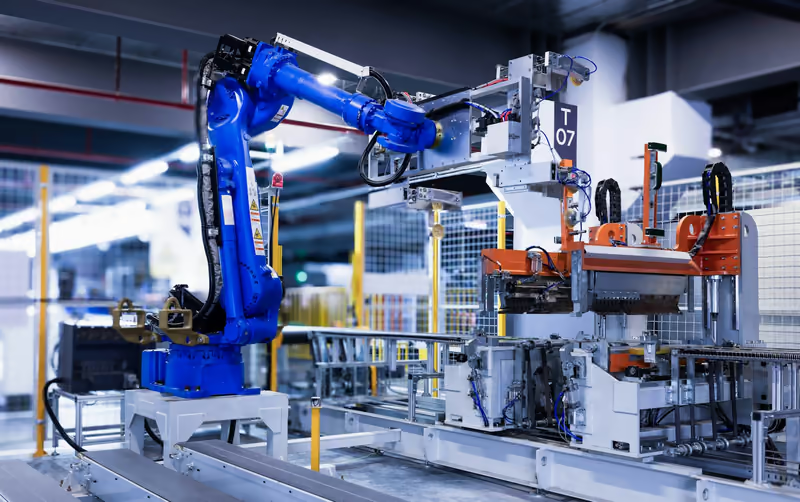
Structural and enclosure parts for robotics programs, where volumes sit between prototype and full production.
What is different about this sector
Robotics programs sit in the awkward middle of the volume curve. Quantities are too high for one-off prototyping to be economic and too low for production tooling to pay back, and they change faster than tooling can be amortised.
The right answer is usually a mix of processes on the same assembly: machined structural parts, printed complex geometry, and molding only for the parts whose volume justifies a tool. Choosing per part rather than per program is what keeps cost sane.
Choosing a process per part
| Process | Where it fits in a robotics assembly |
|---|---|
| CNC machining | Structural brackets, mounting plates, gearbox housings, anything carrying load or needing real material properties and tight tolerance. |
| 3D printing | Complex ducting, cable management, sensor mounts, jigs, and any geometry that would need five setups to machine. |
| Sheet metal | Chassis, panels, covers, and frames. Cheapest route to a large, stiff, light structure. |
| Injection molding | Only where a part’s annual volume justifies the tool. Typically covers, grips, and repeated small components. |
| Bridge tooling | Aluminum tools for parts heading to molding once the design freezes, running hundreds to a few thousand meanwhile. |
Materials for structural and enclosure parts
| Material | Chosen for |
|---|---|
| Aluminum 6061-T6 | The default structural metal. Good stiffness to weight, machines fast, anodises well. |
| Aluminum 7075-T6 | Higher strength where deflection matters and weldability does not. |
| PA12 and PA11 (SLS/MJF) | Tough printed functional parts, near-isotropic, no supports needed. |
| Glass-filled nylon | Printed or molded structural parts where stiffness matters more than toughness. |
| POM (acetal) | Gears, bearings, and low-friction moving parts. |
| PC and PC-ABS | Impact-resistant enclosures and covers. |
| TPU | Printed or molded flexible components, bumpers, cable strain reliefs. |
| Carbon-filled composites | Stiffness to weight where the cost is justified. |
Designing for a moving target
- Separate parts that are stable from parts still changing, and commit tooling only for the stable ones.
- Design printed and machined parts with draft and uniform walls from the start if they will eventually be molded, so the same model carries forward.
- Use fasteners and threaded inserts rather than bonded or welded joints while the design is still iterating.
- Standardise on a small set of materials and finishes across the assembly. Every extra material is another supply chain.
- Where a part is likely to change, favor machining and printing, which absorb revision at no tooling cost.
Assembly and sub-assembly
- Threaded insert installation, heat-set and ultrasonic
- Sub-assembly of multi-part enclosures and frames
- Fastener and hardware kitting supplied with parts
- Fit checks against mating parts before shipment
- Serialisation and marking for traceability
Where the assembly matters more than the parts, we fit inserts, bond joints, and ship tested subassemblies rather than loose components. Scope is agreed at quotation.
Also serving
Other industries
Medical injection molding
Molded components for medical devices. This page states what we can evidence for a regulated buyer, and what is still unconfirmed.
Automotive
Components for automotive programs, from prototype through production volumes.
Consumer products
Parts where the surface finish matters as much as the dimensions, and where volumes ramp quickly.
Electronics
Connector housings, PCB enclosures, and switch components in dielectric, flame-rated, and ESD-safe materials.
Questions
Frequently asked
What robotics teams ask when volumes sit between prototype and production. Each answer comes from the sections above.
Ask an engineerWhich process suits which part in a robotics assembly?
CNC machining for structural brackets, mounting plates and gearbox housings that carry load or need tight tolerance in real material; 3D printing for complex ducting, cable guides and low-volume enclosures; sheet metal for chassis, covers and brackets; injection molding once a part is stable and volumes justify a tool, often on a bridge tool first.
Which materials are typical for robotics parts?
Aluminum 6061-T6 as the default structural metal and 7075-T6 where deflection matters, PA12 and PA11 nylons for printed functional parts, PC and PC-ABS for impact-resistant enclosures and covers, POM for gears, bearings and low-friction moving parts, and TPU for flexible components and cable strain reliefs.
How should we design when the product is still changing?
Separate stable parts from changing ones and commit tooling only for the stable ones. Design printed and machined parts with draft and uniform walls from the start if they will eventually be molded, so the geometry does not have to be redone when the volume arrives.
Representative part
What we mold for this sector
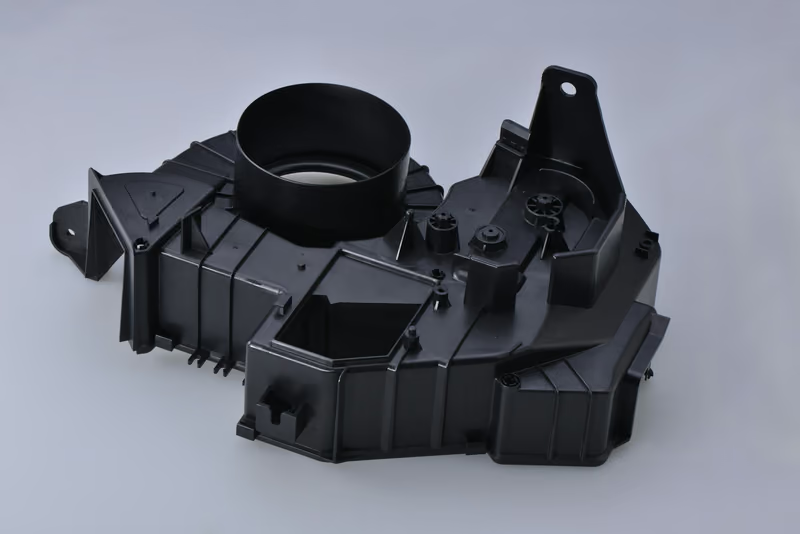
Structural housing
A ribbed structural housing with cast-in bracket lugs, the kind of part that carries load inside an arm or base.
Let’s get started on your part
Send your CAD files and target volumes. We come back with a price, a lead time, and any design notes that would reduce either.