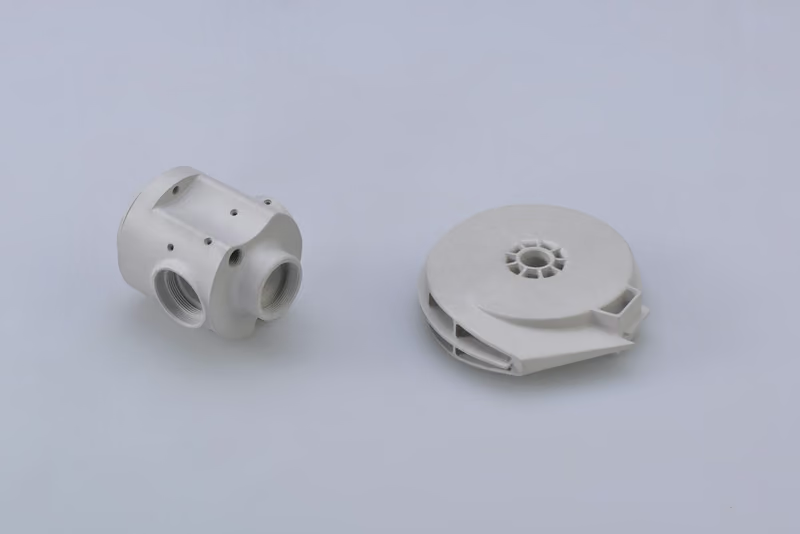
INJECTION MOLDING

Injection molding,
from the tool to the part

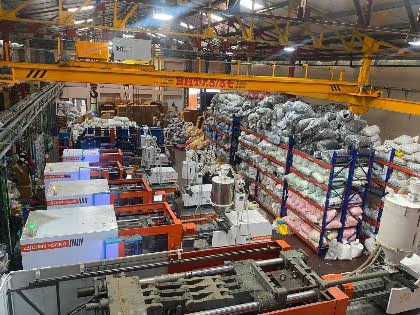
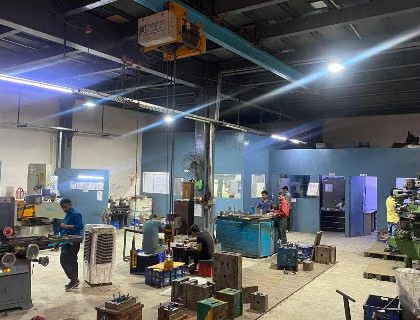
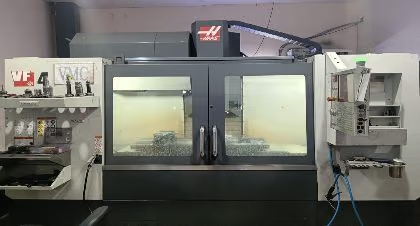
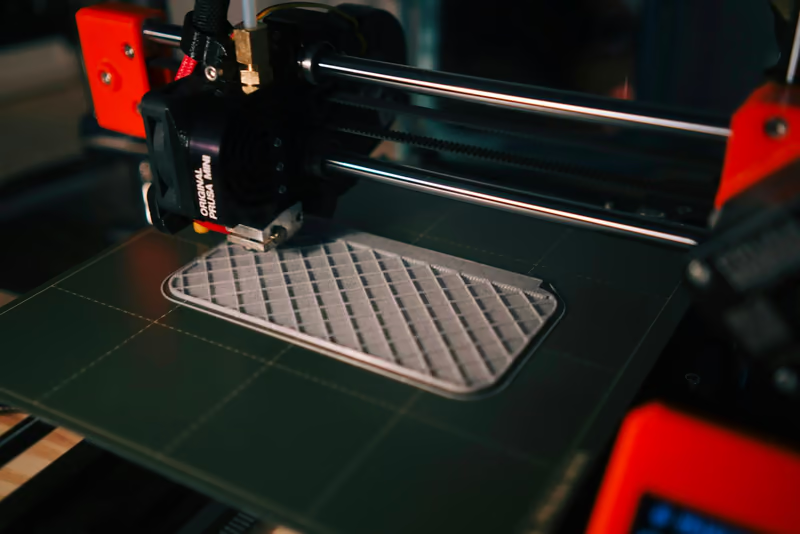
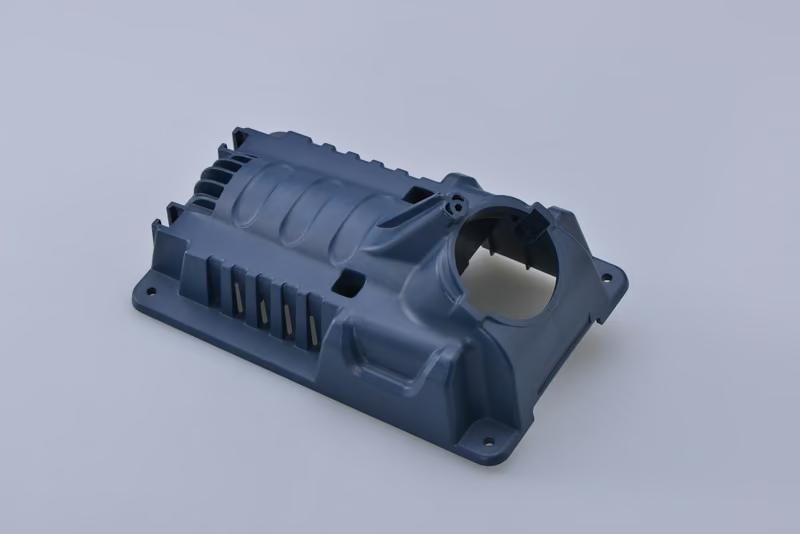
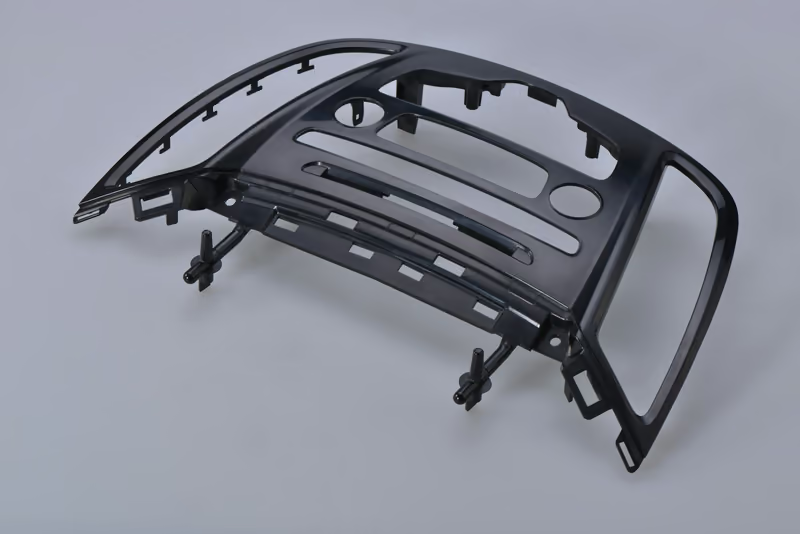
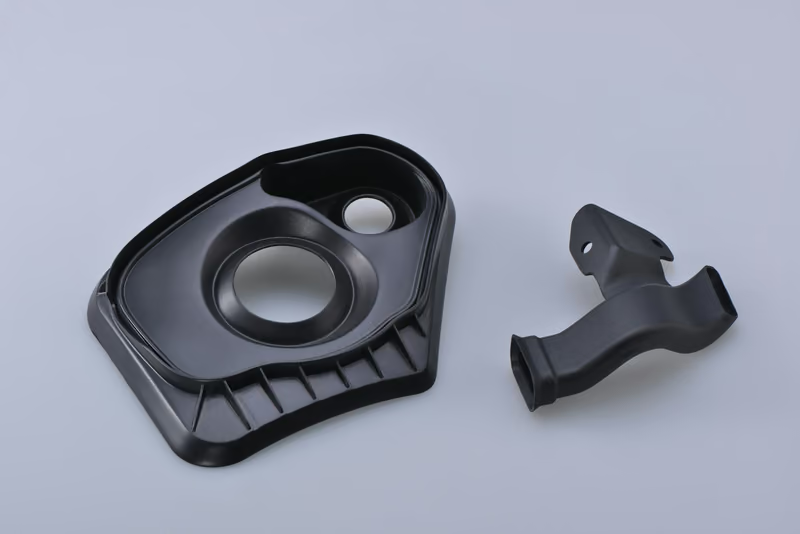
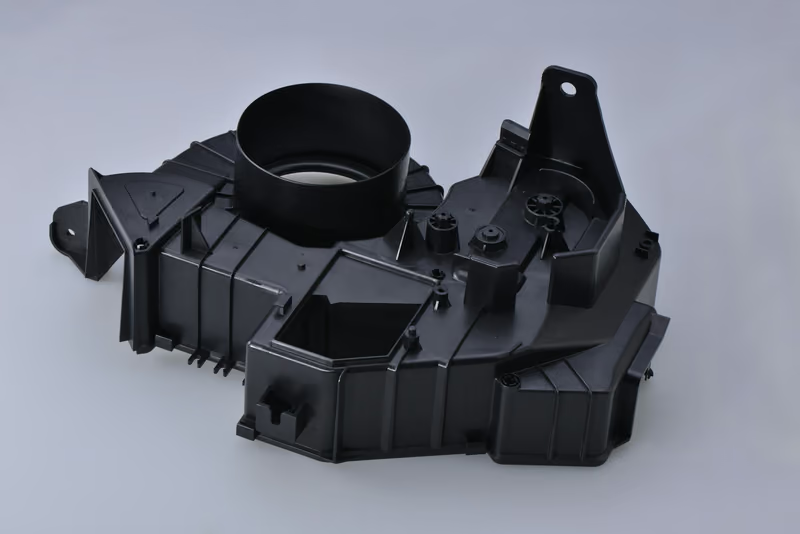
Injection molding and tooling in-house, prototype through to production, with the design review back before any steel is cut. CNC machining, 3D printing, sheet metal and vacuum forming where the part calls for them.

  • Amara Raja
  • Bidso
  • Centralized
  • Exide
  • Honda
  • IIT Madras
  • JSW
  • Lane
  • Madame
  • MAHLE
  • MJ Surgical
  • Nasher Miles
  • Revolut
  • Royal Enfield
  • Sujata
  • Swiss Military
  • Tata
  • UNO Minda
  • VIP
  • Yulu

Customers

What our customers say

Vivek Singhal

Co-Founder @ Bidso

Working with Trumould has been an absolute pleasure, their reliability and commitment to quality are second to none. All the projects have been really seamless and we can always count on them. As we look to the future we are excited to partner with Trumould as our growth partner.
Vivek Singhal, Co-Founder at Bidso

Samarjeet Singh

Project Lead @ Yulu

Trumould really did a fantastic job in making the mold in 2 weeks and gave the part in 15 days from order date. Team is extremely supportive and take care of all our changes.
Samarjeet Singh, Project Lead at Yulu
01 / 02

How it works

Send a part, get a quote

Three steps, and the answers to the questions buyers ask before placing an order.

01

Send your files

STEP, IGES, or STL, plus a drawing if you have tolerances that matter.

02

Tell us the volumes

Prototype quantity, first production run, and expected annual volume.

03

We review and quote

With any design notes that would reduce cost or risk.

Start a project

Tell us about your requirement

The more of this you fill in, the more useful the first reply is. Nothing here is required except a way to reach you.

Submitting opens your email client with these details filled in, addressed to info@trumould.com. Attach your CAD there, STEP, IGES, STL, or X_T.

What comes back

A price, a lead time, and any design notes that would reduce either. If a design cannot be made economically as drawn, we say so and explain why.

Your files

CAD is held on access-controlled cloud storage, reachable only by the engineering team assigned to your project. A mutual NDA is available on request and signed before quotation. Files are retained for the life of the tooling relationship and deleted on written request once the tool is transferred or scrapped.

Prefer to talk?

+91 81303 05815
info@trumould.com

Monday to Friday, 9:00 to 18:00 IST

Questions

Frequently asked

The things buyers ask before the first order. If yours is not here, an engineer will answer it directly.

Ask an engineer
Who owns the molds?

We at Trumould believe that your mold is an asset. You are investing in a mini-machine to earn profits from it, so the ownership of production mold or series tooling belongs to you. In the case of production tooling the ownership rests with you, however a request is sent to ship the mold. In practice that means the tool stays on our floor while it is in production so we can run it, maintain it, and correct it without shipping delays, and it leaves whenever you ask for it. Tooling is quoted as a separate line item from the part price precisely so that what you own, and what you paid for it, is unambiguous.

What are material certificates and why are they relevant?

Every client is shared with a customized mold manual for the tooling which gets developed. This mold manual consists of various certificates. The material certificate establishes which material has been used, the exact grade, the manufacturing company, and various other relevant properties of the material. Choosing the right material is critical to ensure mold life and the quality of the component produced, and the right material helps in achieving the desired finish of the part. The hardness certificate establishes whether the mold has been hardened, which hardening process was chosen, and the actual hardness achieved. Together these matter because tool life and part quality are decided by decisions made before a single shot is molded, and the certificates are the record that those decisions were made correctly rather than assumed.

What are the various surface finish options?

There are several surface finish options we provide for custom parts. There are 12 standard plastic surface finish types, divided into four categories ranging from smooth finishes to rougher ones: glossy, semi-glossy, matte, and textured injection molding surface finishes. The finish is cut and polished into the cavity steel, so it has to be decided before the tool is finished rather than after the first samples arrive. Higher gloss levels need harder steel, more polishing hours, and better-behaved materials, and they show sink marks and weld lines that a matte or textured finish would hide. If cosmetics matter on your part, tell us at quote stage which surfaces are visible and we will specify the finish and the parting line around them.

Do you produce plastic parts and injection molding runs?

Yes, we run the mold for you, which is generally termed on-demand manufacturing. Our owned fleet runs from 25 to 3000 tons, handling parts from a few grams to 8 kg. Above 8 kg we run larger presses through partner facilities, up to 4000 tons and 15 kg shot weight. There is no contractual MOQ, so you do not have to carry excess inventory, though the minimum economic run is typically 500 pieces to justify setup; below that we usually recommend CNC or 3D printing and quote those instead. On existing tooling, lead times are as low as 3 working days from PO. New tooling adds 4 to 8 weeks to first article, depending on tool class and complexity. Because there is no minimum, you can order to your actual demand rather than to a supplier's batch size, and the tool sits ready between orders instead of forcing you to buy a year of stock at once.

What are the various plastic materials available to choose from?

We offer a wide variety of materials to choose from: ABS, PMMA (acrylic), HDPE, PEEK (Victrex 450G or equivalent), LDPE, nylon 6 / PA 6, nylon 66, PBT, PC (polycarbonate), PC-ABS, PEI (Ultem), PET, PLA, polyethylene (PE), polypropylene (PP), polystyrene (PS), POM / Delrin acetal, PPE-PS, PPS, PSU, PVC, TPE (elastomer), and TPV (rubber). Our materials library documents properties, processing parameters, grades, and alternatives for each of the commonly specified ones. If your specification names a grade we do not hold, we source it. If you know the property you need rather than the polymer, tell us that instead and we will propose grades that meet it at different price points.


What industries does Trumould serve?

A wide variety of industries benefit from the highly versatile process of injection molding, including but not limited to medical and pharmaceutical, electronics, construction, food and beverage, automotive, toys, agriculture, consumer goods, sporting goods, industrial goods, electric vehicles, drones, and startups. The requirements differ sharply between them: medical work needs validation documentation and material traceability, automotive needs PPAP and documented process control, consumer work is judged on cosmetics, and startups need the tooling decision to match a volume forecast that has not settled yet. Tell us the sector at quote stage so the process plan is built to it rather than retrofitted.

What secondary services do you provide?

Heat staking, which locally heats a plastic component in order to reform it and insert another component such as a threaded insert. Laser engraving of text or a design. Pad printing, which applies an ink-based 2D design to a 3D surface. Painting, with primer and top coat, standard colors or Pantone matching, masking available, and EMI copper paint. Ultrasonic plastic welding, where a high-frequency welder generates heat to join or reform thermoplastics. Metalising and chrome plating, a metal coating on ABS parts to give a metallic look and shine. We also handle assembly, packaging, and finishing so parts arrive ready for distribution rather than needing another vendor after us.

How can a client track the real-time progress of their mold?

Every client is assigned a dedicated project manager who ensures your requirements are translated into a clear product design and who stays with the program from quote to delivery. You receive weekly updates in the form of a Gantt chart showing where the tool is against the plan: design, steel ordered, machining, assembly, trial, sampling, and approval. Because the chart is against the original schedule rather than a rolling estimate, slippage is visible when it happens rather than at the end. You can reach your project manager directly with any query instead of going through a sales channel.

What are injection mold components?

An injection mold can be thought of as a die which carries the imprint of the part that needs to be manufactured. The components of a mold are the top plate, bottom plate, ejection pins, sprue, runner, and gates, with sliders and lifters where the geometry needs them. Side actions are frequently the reason a tool costs more than the part suggests. The cavity and core together form the part; the runner and gate carry melt from the machine nozzle into it; the ejector system pushes the part off the core once it has cooled enough to hold its shape; and cooling channels through the plates remove the heat that governs cycle time. Sliders and lifters are added when the part has an undercut that cannot be released by opening the tool in a straight line.

What is the cost of injection molding?

Injection molding cost may vary depending on factors such as complexity, part size, mold material, and how much quantity is to be produced. It also depends on which process is used in designing and building the mold. Simple and larger parts may require lower cost. In practice the price a buyer pays is made of four things: the tooling amortised over the volume you commit to, the material by shot weight, the machine time set by the cycle, and any secondary operations. Tooling dominates at low volume and becomes irrelevant at high volume, which is why the same part can be cheaper machined at 200 pieces and far cheaper molded at 20,000.

How long does it take to get a quote?

We return a quote within 24 to 48 hours through our semi-automated quoting process, and every quote includes a complimentary DFM review rather than charging for it separately. The quote covers unit price at your volume, tooling cost where tooling is required, the lead time, and any notes on the geometry that would raise cost, lengthen the tool, or risk a defect in production. Complex multi-cavity tools or assemblies with many components can take longer, and we tell you the same day if that is the case. Send a 3D model in STEP, IGES, Parasolid, or native CAD, plus a 2D drawing wherever the tolerances are tighter than the general profile.

Let’s get started on your part

Send your CAD files and target volumes. We come back with a price, a lead time, and any design notes that would reduce either.

Message us on WhatsApp →