
Industry
Industrial equipment
Wear parts, housings, and replacement components, often in engineering grades and modest volumes.
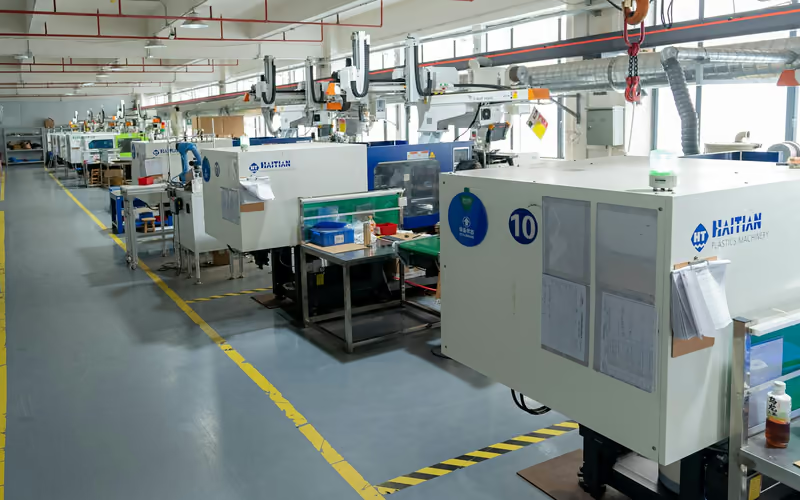
What is different about this sector
Industrial parts are usually replacements rather than new designs. The part exists, it wears out, and the drawing has been lost or never existed, so the job starts with a worn sample rather than a model.
Volumes are modest and repeat, which changes the economics. Tooling rarely pays back, machining and printing usually do, and holding a proven model on file matters more than unit price.
Working from a sample instead of a drawing
Reverse engineering a worn part is not simply measuring it. The part in your hand has lost material where it mattered most, so the measurements have to be interpreted rather than copied.
- Measure the sample by CMM or 3D scan, then build a clean parametric model rather than a scan mesh.
- Identify worn surfaces and restore them to nominal, using unworn areas as the reference.
- Infer the original tolerances from the fits: a bearing seat and a clearance hole were never held to the same tolerance.
- Identify the material by testing where it matters, rather than assuming from appearance.
- Confirm the model against the mating parts before cutting metal, since the sample may itself have been a non-standard repair.
- Keep the model on file so repeat orders skip the whole exercise.
Materials for wear and service life
| Material | Chosen for |
|---|---|
| Steel 4140, hardened | Shafts, gears, and load-bearing wear parts. Specify the required hardness condition. |
| Tool steels (D2, A2) | High abrasion resistance in cutting and forming applications. |
| Stainless 304 and 316 | Corrosion resistance in wash-down, food, and chemical environments. |
| Bronze and brass | Bushings and bearing surfaces where self-lubrication helps. |
| UHMW-PE | Wear strips, guides, and low-friction sliding surfaces. Excellent abrasion resistance. |
| Cast nylon (PA6) | Gears, rollers, and sheaves. Tough and quieter than metal, but absorbs moisture. |
| POM (acetal) | Precision low-friction parts with better dimensional stability than nylon. |
| PTFE | Chemical inertness and the lowest friction, where loads are light. |
| PEEK | High temperature and chemical resistance where metal is unsuitable. |
Choosing a process for replacement parts
- Machining is the default. No tooling, real material properties, and it handles one-off and repeat quantities equally well.
- Printing suits complex geometry, obsolete parts needed urgently, and patterns for casting.
- Sheet metal covers guards, panels, hoppers, and frames.
- Molding only makes sense where a consumable part is used in genuinely high annual quantities.
- For a part needed tomorrow, printing a functional stand-in while a machined part is cut is often the right call.
Repeat supply and documentation
- Models and drawings retained so repeat orders need no re-engineering
- Material certificates traceable to grade and heat lot where required
- Dimensional reports on nominated critical features
- Consistent supplier and process between orders, so parts interchange
- Notification before any material or process substitution
Repeat orders are produced from the retained model and the original material specification, priced against the first order, and re-quoted only where you change something or a material becomes unavailable.
A glass filled engineering polymer can carry real load, but not in the same shape as the metal part it replaces. Stiffness has to be rebuilt with ribs and section, and the fibers line up with the flow, so the part is stronger along the direction the melt travelled than across it. Gate position is therefore a structural decision.
Also serving
Other industries
Medical injection molding
Molded components for medical devices. This page states what we can evidence for a regulated buyer, and what is still unconfirmed.
Automotive
Components for automotive programs, from prototype through production volumes.
Consumer products
Parts where the surface finish matters as much as the dimensions, and where volumes ramp quickly.
Questions
Frequently asked
What industrial buyers ask about replacement and wear parts. Each answer comes from the sections above.
Ask an engineerCan Trumould make a replacement part from a worn sample with no drawing?
Yes. Reverse engineering a worn part means interpreting measurements rather than copying them, because the sample has lost material where it mattered most. The sample is measured by CMM or 3D scan, wear surfaces are restored to design intent, a model and drawing are produced for your approval, and both are retained so repeat orders need no re-engineering.
Which materials suit wear and service life?
Steel 4140 hardened for shafts, gears and load-bearing wear parts, tool steels such as D2 and A2 for abrasion resistance, stainless 304 and 316 for corrosion, and engineering plastics such as POM, PA6 nylon, PTFE and UHMW-PE for low-friction, non-marking wear surfaces.
Which process is best for replacement parts?
Machining is the default: no tooling, real material properties, and it handles one-off and repeat quantities equally well. Printing suits complex geometry and obsolete parts needed urgently; sheet metal suits guards, covers and brackets; molding pays off only where a replacement is needed in volume.
Representative part
A part we can make
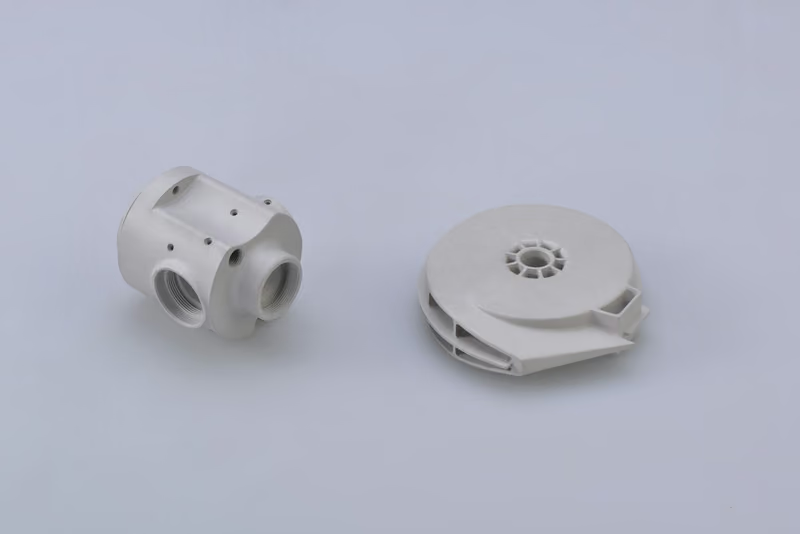
Ported housing and impeller cover
Two molded housings of the kind that go into pumps, blowers and fluid handling equipment. Threaded ports, mounting bosses and ribbed webs, all molded in one shot rather than machined and assembled afterwards.
Let’s get started on your part
Send your CAD files and target volumes. We come back with a price, a lead time, and any design notes that would reduce either.