
Industry
Medical injection molding
Molding for device makers who need the documentation as much as the part: traceability to resin lot, change control, and validation support where the device requires it.

What is different about this sector
Medical buyers do not qualify a supplier on price and lead time. They qualify on evidence: a quality system that can be audited, material traceability that survives a recall investigation, and process validation that proves the hundred-thousandth part matches the first.
That is why this page states certification status as confirmed or unconfirmed rather than implying capability. A claimed certification that turns out not to be held is a commercial and regulatory exposure for both sides.
Standards that apply
| Standard | What it covers |
|---|---|
| ISO 10993 | Biological evaluation of medical devices. The framework under which biocompatibility is assessed for a finished device. |
| USP Class VI | A materials-level biological reactivity test. Applies to a specific resin grade and lot, not to a polymer family. |
| IQ, OQ, PQ | Installation, operational, and performance qualification. The validation sequence proving a process reliably produces conforming parts. |
| 21 CFR Part 820 | US FDA Quality Management System Regulation (QMSR). Since 2 February 2026 it incorporates ISO 13485:2016 by reference and replaces the former Quality System Regulation for device design and manufacture. |
Materials commonly specified
Biocompatibility belongs to a named grade with a certificate, never to a polymer family. "Medical grade polycarbonate" is not a specification; a named grade with USP Class VI or ISO 10993 documentation is.
| Material | Typical medical use |
|---|---|
| Polycarbonate | Housings, luer fittings, transparent components requiring impact strength and clarity. |
| Polypropylene | Syringes, labware, single-use disposables. Autoclavable and chemically resistant. |
| PEEK | Implantable and reusable instruments where high temperature and repeated sterilization apply. |
| Polysulfone (PSU) | Components requiring repeated steam autoclaving without loss of properties. |
| ABS and PC-ABS | Non-patient-contact housings and enclosures for diagnostic equipment. |
| Silicone and TPE | Seals, gaskets, soft-touch overmolded grips, tubing components. |
| POM (acetal) | Precision moving parts inside devices, gears and mechanisms. |
What a regulated buyer needs with the parts
- Material certificates traceable to resin grade and lot, retained for the required period
- First article inspection and dimensional reports against the controlled drawing
- Process validation documentation covering IQ, OQ, and PQ where the device requires it
- Change control, so no material, tool, or process change happens without notification and approval
- Lot traceability from finished part back to resin lot and production run
- Device master record and design history file inputs where the molder holds them
What the device master record needs from a molder
The device master record is the manufacturer’s controlled file describing how the finished device is made. A molder does not own it, but supplies inputs to it: the approved drawing revision the parts are made to, the material specification down to grade and supplier, the process parameters the validated process runs at, the inspection method and acceptance criteria, and the change control record showing that none of those moved without approval. Ask for these as a package at first article rather than assembling them later from emails.
USP Class VI is not the only test that matters
In short: USP Class VI tests a resin grade, while ISO 10993 evaluates the finished device. USP <88> Class VI covers biological reactivity of the plastic in vivo, and it is the right question for a part that touches tissue or fluid. It is not the right question for primary pharmaceutical packaging, where USP <661.1> on plastic materials of construction and <661.2> on the finished packaging system apply instead. ISO 10993 sits above both as the device-level biological evaluation framework: the material evidence is an input to it, never a substitute for it.
Grades commonly specified where Class VI evidence exists include Makrolon Rx polycarbonate, Radel R polysulfone, PEEK Optima for implantable work, and Zeonex cyclo-olefin for optical clarity. Evidence is held per grade and per lot, so name the grade on the drawing and ask for the certificate against the lot that ran your parts.
Sterilization changes the material choice
| Method | Runs well | Watch out for |
|---|---|---|
| Steam autoclave, 121–134 °C | PSU, PEI, PEEK, PP homopolymer, silicone | PC hydrolyses and crazes over repeated cycles; ABS distorts |
| Ethylene oxide | Most thermoplastics, including PC, ABS, PP | Needs a degassing period; absorbed residuals must be shown to clear |
| Gamma irradiation | PP with a stabilizer package, PSU, PEI | PC yellows; PA6 and acetal chain-scission and embrittle; unstabilized PP loses impact strength |
| E-beam | Similar to gamma at lower dose penetration | Same polymer sensitivities, dose-dependent |
Decide the sterilization method before the material, not after. Changing method after the tool is cut frequently forces a grade change, and a grade change with a different filler or stabilizer package shrinks differently, which is a tool change.
Which of these apply to your program, and whether each is standard or quoted, is confirmed in writing with your quotation. Nothing is claimed here that a certificate or a record cannot support.
A regulated buyer is not buying parts, they are buying parts plus the evidence that the process which made them is under control. Installation qualification records what the equipment is, operational qualification proves it runs across its stated range, and performance qualification proves it makes conforming parts repeatedly. After that, nothing changes without a documented change control.
Typical applications
- Diagnostic instrument housings and covers
- Single-use disposables and fluid-path components
- Surgical instrument handles and overmolded grips
- Labware, cartridges, and consumable assemblies
- Enclosures for point-of-care and imaging equipment
- Precision internal mechanisms and drive components
Also serving
Other industries
Automotive
Components for automotive programs, from prototype through production volumes.
Consumer products
Parts where the surface finish matters as much as the dimensions, and where volumes ramp quickly.
Robotics
Structural and enclosure parts for robotics programs, where volumes sit between prototype and full production.
Questions
Frequently asked
What device makers ask before qualifying a molder. Each answer comes from the sections above.
Ask an engineerWhat documentation does Trumould supply for medical molded parts?
Material certificates traceable to resin grade and lot and retained for the required period, first article inspection and dimensional reports against the controlled drawing, process validation documentation covering IQ, OQ and PQ where the device requires it, change control on tool and process, and lot traceability on shipped parts.
Which standards apply to medical injection molding?
ISO 10993 for the biological evaluation of the finished device, USP Class VI as a materials-level biological reactivity test, and 21 CFR Part 820, the US FDA Quality Management System Regulation, which since 2 February 2026 incorporates ISO 13485:2016 by reference. Biocompatibility belongs to a named resin grade with a certificate, never to a polymer family.
What kinds of medical parts does Trumould mold?
Diagnostic instrument housings and covers, single-use disposables and fluid-path components such as manifolds, surgical instrument handles and overmolded grips, labware, cartridges and consumable assemblies, and enclosures for point-of-care and monitoring equipment.
What should I look for in a medical device injection molding company?
A molder that states certification as confirmed or unconfirmed rather than implying it, that can produce USP Class VI or ISO 10993 evidence against a named resin grade and lot rather than a polymer family, that documents IQ, OQ and PQ where the device requires it, and that runs change control so no material, tool or process change happens without notification and approval. Ask for material certificates, first article inspection reports and device master record inputs as a standard package at first article, not assembled later from emails.
Representative part
What we mold for this sector
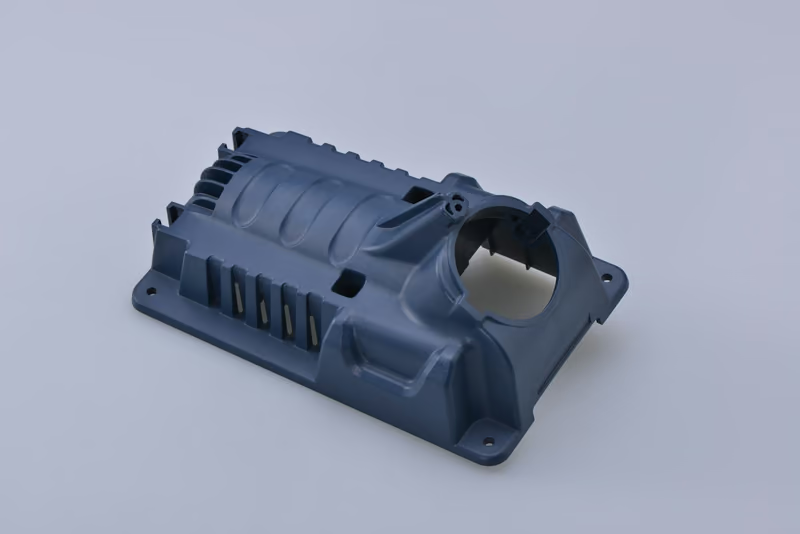
Molded manifold
A multi-port manifold molding of the kind used in fluid handling assemblies, run in a medical grade polymer.
Let’s get started on your part
Send your CAD files and target volumes. We come back with a price, a lead time, and any design notes that would reduce either.